
Have you ever noticed how a stressful day often ends with a familiar, throbbing pain, making you question the undeniable stress migraine link? As someone who has walked this path for years, I know that feeling all too well, and our community data shows that up to 80% of us identify stress as a direct catalyst. Together, we will explore not just how daily hassles trigger attacks, but also the surprising ways relaxing after a tough week can be a trap. We’ll uncover the science in simple terms and, most importantly, what practical steps you can start taking today to regain some control.
- That familiar feeling: why stress feels like your migraine’s best friend
- How stress actually pulls the migraine trigger
- The cruel paradox: the “let-down” migraine after the storm
- Stressors are not all the same: what’s filling your bucket?
- What you can do today: practical steps to manage the stress-migraine link
- You are not alone on this path
- Sources
That familiar feeling: why stress feels like your migraine’s best friend
You know the feeling. A stressful day, a building pressure, and then it arrives. That familiar, unwelcome ache behind your eye. You know exactly where this is heading. It feels inevitable, doesn’t it? For years, I’ve lived this same pattern, and I know I’m not the only one.
The stress-migraine connection is not just in your head
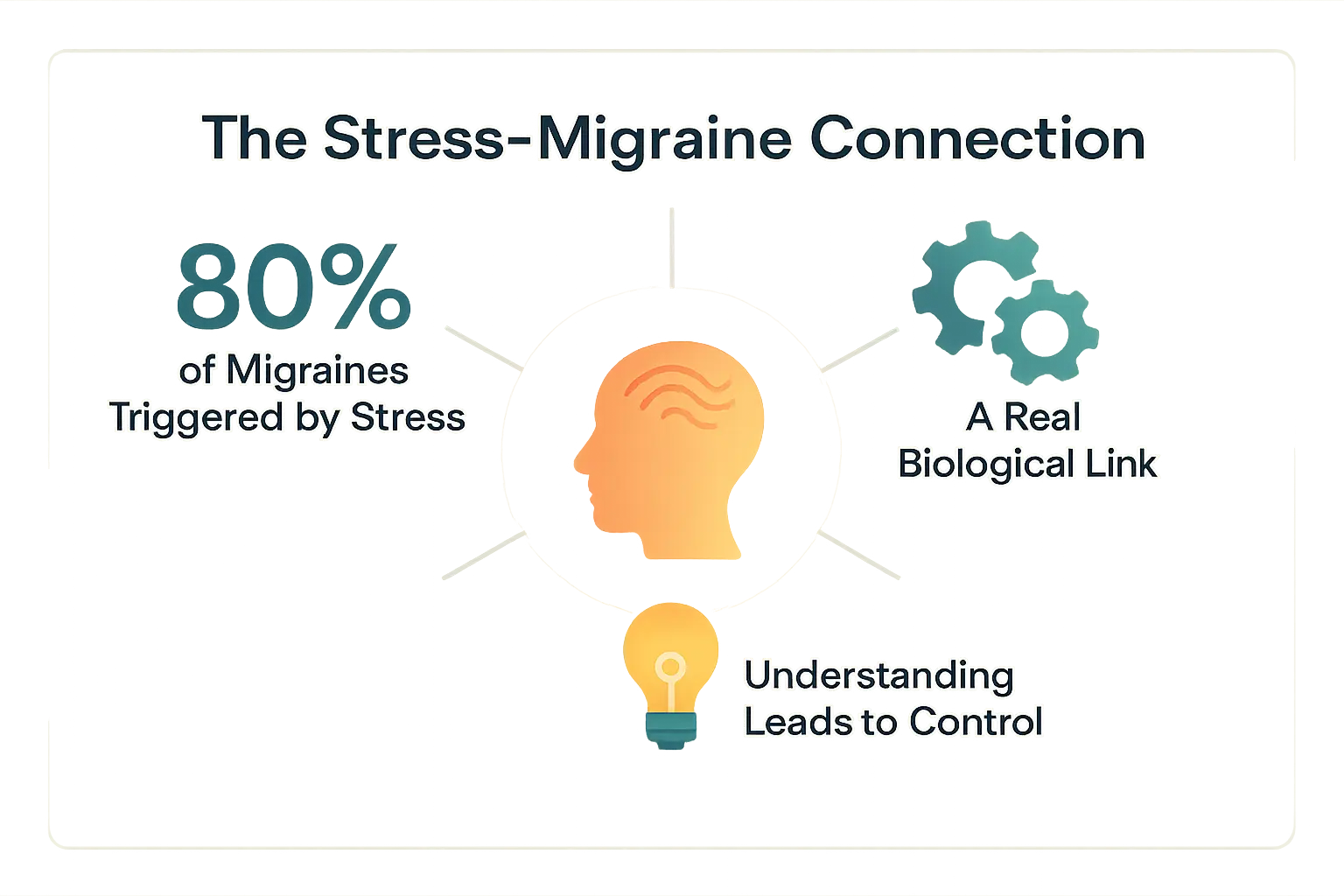
If you’ve thought, “My stress is causing my migraines,” you are right. This isn’t just a feeling; it’s a reality. Studies show that up to 80% of us report stress as a direct catalyst. This is a biological response, not a weakness. Understanding this stress migraine link is the first step toward regaining control.
What we’ll uncover together
In this article, we’ll explore this complex relationship. We’ll look at the science—in simple terms—and the strange paradox of “let-down” migraines that appear when you finally relax. Most importantly, we’ll focus on what you can do about it today. Together, let’s find practical ways to manage this challenge. Every small step counts.
How stress actually pulls the migraine trigger
If you live with migraine, you know stress is a major player. But the link is more complex than “I’m stressed, so I get a migraine.” As someone who has navigated this for years, I want to share what I’ve learned about how stress impacts a migraine brain, based on experience and community data.
The daily grind and the “stress bucket” effect
Imagine your resilience as a “stress bucket.” Each day, small things fill it: poor sleep, a missed meal, a tough conversation. A migraine often isn’t from one big event, but the accumulation of these daily hassles causing your bucket to overflow.
Many in our community notice more small annoyances one to three days before an attack. Chronic stress keeps your brain on high alert, making it “hyperexcitable.” In that state, any extra stressor can be the final straw. It’s one of the most common migraine triggers we see.
The vicious cycle: migraine causes stress, stress causes migraine
Here’s a familiar pattern: a frustrating feedback loop. You worry about getting a migraine, which is a form of stress. That stress can then trigger the attack you feared. The pain and disruption from the migraine cause even more stress, and the cycle continues.
This exhausting loop can turn occasional attacks into a chronic issue. The constant worry can severely impact your migraine daily life. You are not alone in this.
It’s not just “in your head”: the body’s chemical reaction
When you’re stressed, your body reacts chemically by releasing hormones like cortisol. The problem? A migraine brain craves stability and hates sudden changes.
A sharp spike or a sudden drop in cortisol can be seen by your brain as a threat, setting off the migraine cascade. Your brain’s stress response center goes into overdrive, and pain follows. It’s a physical reaction, not a personal failing.
The cruel paradox: the “let-down” migraine after the storm
Living with migraines means learning your body’s strange logic. But one pattern feels particularly cruel, a paradox that baffles many in our community: the “let-down” migraine. It’s a frustratingly common experience.
When relaxing is the trigger
You’ve survived a hellish week. It’s finally Saturday morning. You relax… and then, boom. The migraine hits. This isn’t bad luck; it’s a known phenomenon called the “let-down headache”.
Studies confirm this. Research shows that a reduction in stress significantly increases migraine risk. The most vulnerable period? The six hours immediately following that perceived drop in stress.
I’m not a doctor, but the science points to cortisol. During stress, cortisol levels are high. When the pressure drops, so does cortisol. This abrupt plunge is what your sensitive brain can interpret as a trigger.
Why weekends and vacations can be minefields
This explains why the first day of vacation or a peaceful Saturday can become a battleground. It feels incredibly unfair. You finally get a break, and your body seemingly betrays you.
But recognizing this pattern is a victory. Knowing this trigger exists means you can start to anticipate it. You are not alone in this; it’s a frequent topic among our users.
Common ‘let-down’ scenarios our community reports:
- Post-exam period: After days or weeks of intense study.
- The day after a major project deadline.
- The start of a long-awaited vacation.
- Saturday mornings after a stressful work week.
Stressors are not all the same: what’s filling your bucket?
When we say “stress” triggers a migraine, it’s more than a bad day. From my experience, a “stressor” is anything that asks your body to adapt. Imagine a bucket where every challenge adds a drop of water. A migraine can strike when that bucket overflows. The key is figuring out what’s filling yours.
Emotional, physical, and environmental stressors
To become a detective for your own health, let’s break down what these stressors look like. Recognizing them is the first step toward management.
| Type of Stressor | Examples for You | What it feels like |
|---|---|---|
| Psychological/Emotional | Work pressure, family conflict, financial worries, fear of the next attack. | Feeling overwhelmed, anxious, or sad. |
| Physical | Lack of sleep, intense exercise (for some), illness, hormonal shifts. | Feeling physically drained, tense muscles. |
| Environmental | Bright or flickering lights, loud noises, strong smells, weather changes. | Feeling overstimulated, senses on high alert. |
When the stress is deeper: the role of trauma and ptsd
This is a difficult topic, but for some, the roots of stress run deeper. I’m not a therapist, but it’s important to share what studies show, as you are not alone.
There’s a significant link between migraine and past trauma. Research shows a high prevalence of PTSD (Post-Traumatic Stress Disorder), with some studies suggesting up to 1 in 4 people with primary headaches might meet the criteria.
Essentially, a traumatic event can leave the nervous system on permanent high alert—a state called “central sensitization.” This makes the brain more likely to interpret minor stressors as threats, triggering a migraine. If this resonates, it may be a path worth exploring with a professional. Every small step toward understanding is a victory.
What you can do today: practical steps to manage the stress-migraine link
Understanding the link is one thing, but what can you actually do? I’ve been there, feeling helpless. But I’ve learned that small, consistent actions build a powerful defense. You’re not powerless. Let’s walk through some practical steps you can start today. Each one counts.
Build your anti-stress fortress: consistency is key
The best defense against stress-related migraines is a predictable routine. Your migraine brain thrives on stability. Think of it as building a fortress to protect your nervous system. This isn’t about rigid perfection, but a gentle, consistent rhythm.
- Regular Sleep: Go to bed and wake up around the same time, even on weekends. This stabilizes your brain’s internal clock.
- Consistent Meals: Don’t skip meals. This prevents blood sugar drops, a common physical stressor.
- Gentle, Regular Exercise: Think walking or yoga. It helps burn off stress hormones, but be careful, as intense exercise can be a trigger for some.
- Hydration: Staying hydrated is a simple but powerful way to keep your body in balance.
In-the-moment stress relief techniques
Routines are for prevention, but what about when tension creeps in? You need tools for the moment. These aren’t magic cures, but skills that, with practice, can calm your nervous system before it hits the panic button.
- Deep Breathing: A simple 4-7-8 technique (inhale for 4, hold for 7, exhale for 8) can quickly calm your nervous system.
- Mindfulness & Meditation: Even 5 minutes a day helps. Apps like Calm or Headspace are great starting points.
- Biofeedback: This technique helps you control physical responses like muscle tension. Studies show it can be very very effective for migraine.
- Journaling: Getting worries onto paper is incredibly cathartic and stops anxious thoughts from spinning.
Become a detective: track your stress and migraines
This is my most powerful advice: start keeping a migraine diary. An app like Migraine Buddy can be a game-changer. Tracking your migraine and stress levels helps identify your personal patterns. You’ll stop guessing and start knowing.
You might notice attacks happen the day after stress, a classic pattern. This is how you truly understand your unique stress migraine link. You are the expert on your body; tracking is the tool that proves it.
You are not alone on this path
Every small step is a victory
The link between stress and migraine is a complex dance, especially with the “let-down” paradox. But it’s not a life sentence. Just by reading this, you’ve taken a huge step toward understanding your own patterns. That’s power.
Don’t feel overwhelmed. The goal isn’t to fix everything at once. Choose one small thing to try this week—perhaps a stricter bedtime or five minutes of deep breathing when tension rises. Each small step is a genuine victory.
Your experience matters
Please know this: you are not alone. We are millions, learning and navigating this condition together. Data from our community shows how shared this struggle is. Your observations are a vital piece of this puzzle.
What works for you might be the key for someone else. Share what you notice in your journal or with the community. Be patient and kind to yourself. And remember, if stress and migraine are overwhelming your life, please talk to a headache specialist or a therapist. You deserve support.
Sources
To ensure this information is reliable, I’ve relied on reputable sources. My goal is to share well-researched insights grounded in scientific evidence to help you understand migraines. This is like sharing notes from my journey, backed by experts dedicated to this condition.
- Lipton, R. B., et al. (2014). Reduction in perceived stress as a migraine trigger: testing the “let-down headache” hypothesis. Neurology, 82(16), 1395-401.
- American Migraine Foundation. (Various articles). Stress and Migraine.
- National Headache Foundation. (Various articles). Triggers in the Environment.
- Seminowicz, D. A., et al. (2020). Mindfulness-Based Stress Reduction for Chronic Migraine. JAMA Internal Medicine.
## you are not alone on this path
### every small step is a victory
Understanding the stress-migraine link is empowering. Don’t feel overwhelmed; choose one small step, like a consistent bedtime. Every step is a victory.
### your experience matters
You are not alone. We are millions navigating this together. Be kind to yourself, and seek professional support if needed.