
Does it feel like your migraine has its own calendar, perfectly synced to your period? For years, I experienced this frustrating pattern, and our community data shows thousands of you do too; it’s the undeniable reality of the link between migraines and your menstrual cycle. These attacks often feel more severe and last longer, making that time of the month even more challenging. Together, we’ll explore the science behind why this happens, drawing on established studies and shared experiences. We will uncover practical, actionable steps you can take today to regain control, because understanding this connection is your first powerful step toward relief.
- That monthly migraine? You’re not imagining it, it’s your hormones
- The hormonal rollercoaster: why your cycle triggers migraine pain
- Are your migraines menstrual? How to know for sure
- Navigating your options: what you can do today
- You are not defined by your cycle: taking back control
- References
That monthly migraine? You’re not imagining it, it’s your hormones
Does it ever feel like your migraine has its own calendar, perfectly synced with your period? For years, I dreaded that specific time of the month. Not just for the usual reasons, but because I knew a debilitating migraine was on its way. A different kind of pain, more relentless and stubborn.
If this sounds familiar, you’re not alone. Far from it. Our community data from thousands of users shows a clear, undeniable pattern. This isn’t “just another migraine.” It’s a specific variant known as migraine menstruelle, directly tied to your cycle menstruel. Studies confirm this, showing that up to two-thirds of women with migraine experience this cyclical attack.
The pain can be more intense. It can last longer. It can feel more resistant to your usual treatments. It’s real, and it has a name. The sudden drop in estrogen just before your period is the main culprit, making your brain more sensitive to pain triggers.
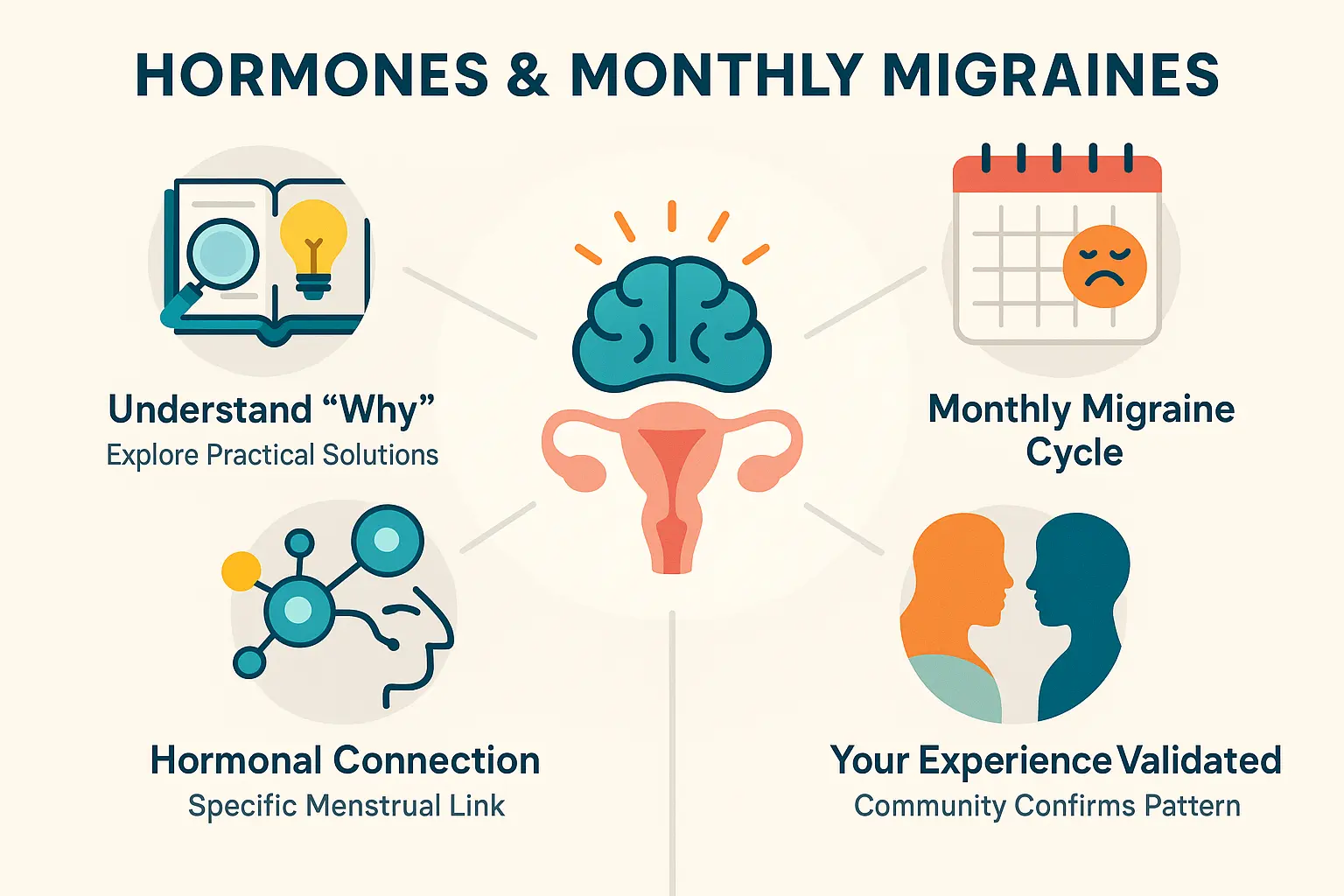
But you are not powerless. Understanding the “why” behind this monthly assault is the first step toward regaining control. Together, we’ll look at the science in simple terms, explore what our community has learned through tracking, and outline practical steps you can start taking today. Each small piece of knowledge is a tool in your kit.
The hormonal rollercoaster: why your cycle triggers migraine pain
If you’ve noticed your migraines sync up with your menstrual cycle, you are absolutely not imagining it. This is a reality for so many of us. I’ve been there, tracking my own attacks for years, and our community data confirms it: hormones are a major migraine trigger. But why? Let’s break it down, without the complicated medical-speak.
The estrogen drop: your brain’s main suspect
The main hormone to watch is estrogen. Most of the month, it’s quite helpful. Think of it as a natural painkiller and a traffic controller for the blood vessels in your brain, helping keep things running smoothly.
The problem starts with the sudden drop in estrogen right before your period. This isn’t a gentle decline; it’s a plunge. This abrupt change makes the pain receptors in your brain more sensitive and allows blood vessels to dilate. When estrogen disappears, it’s like rush hour chaos with all the traffic lights down.
Prostaglandins: the second wave of trouble
It doesn’t stop with estrogen. As your period starts, your body releases chemicals called prostaglandins. Their main job is to cause uterine contractions—the source of menstrual cramps. But they don’t just stay in one place.
These same substances increase inflammation and pain sensitivity throughout your body, including your head. So you have the estrogen drop setting the stage, and then the prostaglandins arrive, adding fuel to the fire. It’s a perfect storm for a migraine attack.
Why these migraines feel worse
A key observation, from both clinical studies and our community, is that menstrual migraines often hit differently. They tend to be more severe, last longer, and can be frustratingly resistant to treatments that work the rest of the month.
Another pattern we see is that they are frequently migraines without aura. This can happen even for those who typically experience different types of migraine with aura at other times. Recognizing this is a huge step in understanding your own migraine journey. You’re not alone in this.
Are your migraines menstrual? How to know for sure
Do you suspect your worst migraine attacks align with your period? Many in our community share this feeling. But how can you be certain? It’s a crucial piece of your personal migraine puzzle.
I’m not a doctor, but I’ve walked this path. From my own experience and thousands of user logs, I’ve learned that data is your most powerful ally. Confirming a menstrual link isn’t about a blood test or a scan; it’s all about timing.
Your best tool: the migraine diary
Your memory can be unreliable, especially when in pain. You need hard data. The best way is by keeping a migraine diary for at least three consecutive menstrual cycles. This practical step helps you and your doctor see the patterns. Be precise and track:
- The exact day your migraine attack starts and ends.
- The day your period starts and ends.
- The severity of the pain (on a scale of 1 to 10).
- Any other potential triggers, like lack of sleep or specific foods that can trigger migraines.
Decoding your diary: the “migraine window“
After a few months, look for the “migraine window.” This is a consistent pattern where attacks occur between two days before your period starts and up to the third day of your period. It’s a five-day timeframe where your hormones are shifting.
There are two main types:
- Pure menstrual migraine: Attacks happen ONLY during that five-day window. This is rare, affecting less than 1 in 100 women with migraine.
- Menstrually-related migraine: Far more common, affecting up to 60% of women with migraine. You get attacks at other times, but they are more frequent or severe during this window.
This diary is the most valuable information for your doctor. It transforms a vague feeling into concrete evidence, helping you build a targeted treatment plan together.
Navigating your options: what you can do today
Facing this hormonal link can feel overwhelming, but it gives you a clear window to act. It’s about being proactive. I’m not a doctor, but from my journey and community data, I’ve learned you have more power than you think. Let’s look at what you can do.
First line of defense: lifestyle and supplements
Before medication, focus on what you can control. When you’re hormonally vulnerable, other migraine triggers multiply. The days around your period demand maximum consistency. Think of it as building a fortress.
Here are some practical tips our community finds helpful:
- Sleep consistency: Go to bed and wake up at the same time. A small disruption can be a trigger when defenses are down.
- Steady hydration: Don’t wait until you’re thirsty. Sip water consistently to keep your system stable.
- Stable blood sugar: This is critical. Avoid skipping meals. Eat small, regular meals to prevent blood sugar dips, a known migraine trigger.
- Stress management: Even 10 minutes of mindfulness or gentle stretching can make a real difference.
Many also find relief with magnesium. Studies suggest it may help reduce your brain’s sensitivity during this time. Always talk to your doctor before starting any new supplement.
When to consider medical treatments
Sometimes, lifestyle changes aren’t enough. A conversation with your doctor is essential to navigate medical options safely.
For an active attack, NSAIDs (like ibuprofen) can be effective by targeting prostaglandins. If those don’t cut it, migraine-specific drugs called triptans might be the next step.
There’s also “mini-prevention.” If your cycle is predictable, a doctor might suggest an NSAID or a specific triptan (like frovatriptan) for a few days around your period to stop the attack before it begins.
| Approach | How it works | Best for… | Important note |
|---|---|---|---|
| Lifestyle Management (Sleep, Diet, Hydration) | Reduces overall trigger load when hormonally vulnerable. | Everyone, as a foundational strategy. | Requires consistency, especially around your period. |
| Acute Treatment (NSAIDs, Triptans) | Stops or reduces the pain of an ongoing attack. | Treating attacks as they happen. | Risk of medication overuse headache if used too frequently. |
| Short-Term Prevention (e.g., Naproxen, Frovatriptan) | Taken for a few days around the expected period to prevent the attack from starting. | Predictable cycles where migraines are severe. | Requires a doctor’s prescription and planning. |
| Hormonal Contraceptives (e.g., continuous pill) | Stabilizes estrogen levels, preventing the “drop”. | Women without migraine with aura who also seek contraception. | Can worsen migraines for some; contraindicated for migraine with aura. |
You are not defined by your cycle: taking back control
The link between your migraines and menstrual cycle is real. It’s biological. Understanding this connection is the very first step. I know how overwhelming it can feel, but knowledge is your first tool.
Remember this: what works for one person might not work for you. The real goal is to become an expert on your own body. Your unique patterns, your specific triggers. That’s where your power lies.
Here’s what you can do, starting today:
- Start tracking. Your migraine diary is your most powerful tool. It turns vague feelings into concrete data.
- Share your findings with a doctor you trust. This data transforms your conversation from “I think it’s worse around my period” to “Here are three months of data showing a clear pattern.”
- Be patient with yourself. This isn’t a race. Every small step you take to understand your triggers is a victory.
You are not alone in this. We are a community of millions, all learning and fighting together. You have the strength to navigate this, and we’re here to help you along the way. Each small insight is a win.
References
- The The Migraine Trust – Menstrual Migraine: Ressource sur les mécanismes et traitements de la migraine menstruelle.
- American Migraine Foundation – Menstrual Migraine 101: Guide sur les bases et la gestion.
- National Institute of Neurological Disorders and Stroke (NINDS): Institution de recherche fournissant des informations factuelles.
- Relevant studies from ‘Neurology’ or ‘Headache’: Articles scientifiques sur le lien entre œstrogènes et crises.
You are not defined by your cycle: taking back control
The link between your migraines and menstrual cycle is real, it’s biological, and understanding it is the first step toward managing it. Start tracking today—your diary is your power tool. Share your findings with a trusted doctor, and be patient. Every small step is a victory, and you’re not alone.