
Have you ever felt inexplicably irritable or suddenly exhausted, only to be hit by a full-blown migraine hours or even a day later? Recognizing these subtle migraine premonitory symptoms is more than just understanding your body; it’s about gaining a crucial head start against the impending pain. Many people dismiss signs like excessive yawning, neck stiffness, or unusual food cravings as random occurrences. This guide will teach you how to decode your body’s unique early warnings, transforming that vague “off” feeling into a powerful opportunity to act before the headache phase truly begins and takes control.
- The prodrome phase: your body’s early warning system
- Decoding the signs: the most common premonitory symptoms
- Symptom or trigger? the great migraine mix-up
- The pre-aura: subtle visual disturbances to watch for
- How to become your own migraine detective
- You’ve spotted the signs. now what?
- References
That strange feeling. You probably know the one. It’s not just in your head—it’s a real signal your body is sending. Many people think a migraine starts with pain, but the attack often begins much earlier, sometimes hours or even days before the headache phase kicks in.
This early warning period is known as the prodrome, or premonitory phase. Think of it as a crucial window of opportunity. Recognizing these early migraine premonitory symptoms isn’t just for curiosity; it’s about giving yourself a chance to act before the crisis truly takes hold.
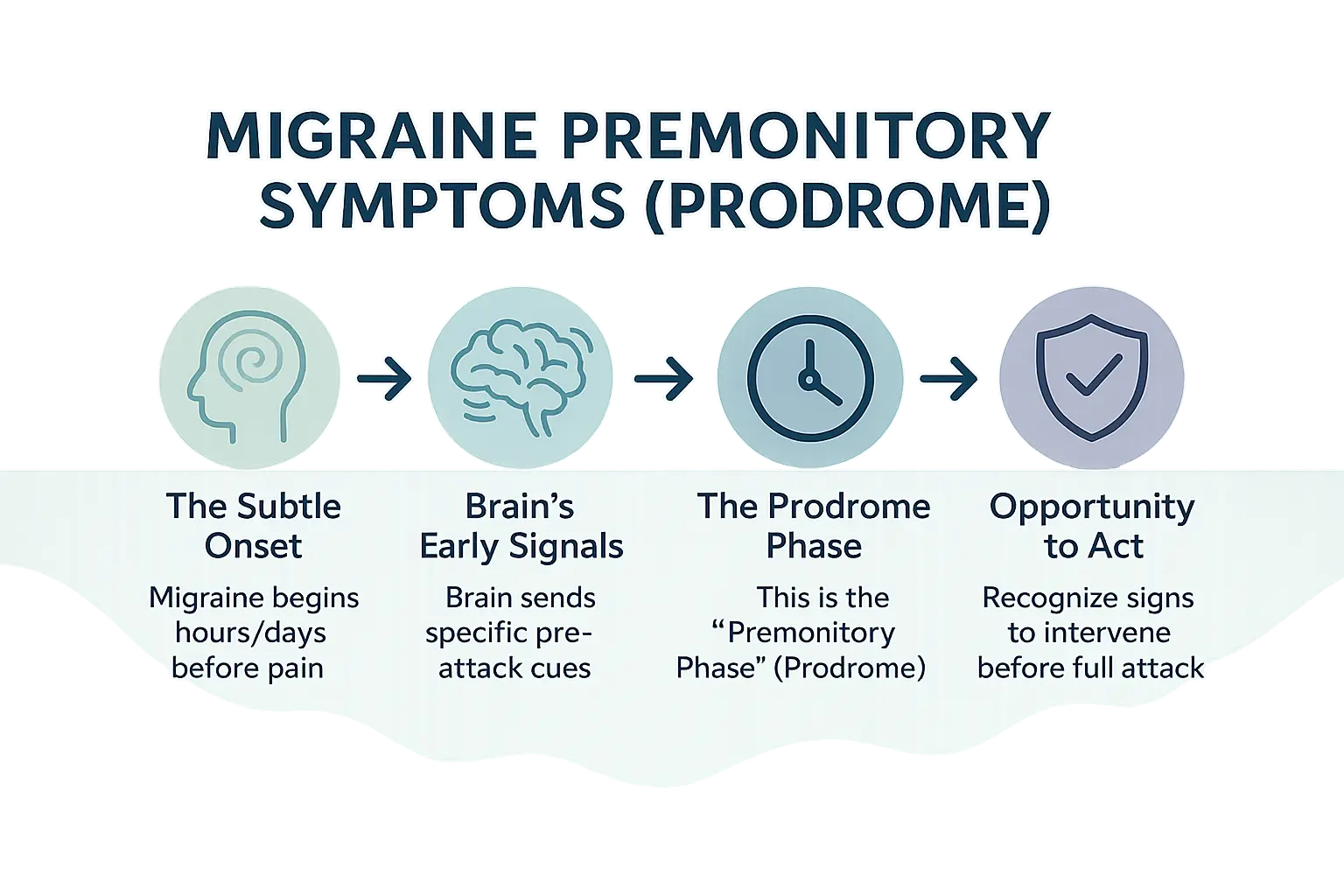
This guide will break down these signs, from common to bizarre, to help you understand what’s happening. Spotting them is the first step in understanding the four distinct phases of a migraine attack and regaining control.
The prodrome phase: your body’s early warning system
Long before the headache hits, your body often sends out subtle signals. This is the prodrome phase, the very first stage of a migraine attack. Think of it as the neurological storm gathering on the horizon. It’s not just a feeling; it’s the real beginning of the event.
This warning window can open anywhere from a few hours to a full two days before the pain begins. That’s a crucial timeframe. A large majority of people with migraines experience these pre-attack symptoms, though many don’t connect the dots right away. You might just feel “off” without knowing why.
It’s vital to distinguish the prodrome from the aura. They are not the same thing.
The aura is a distinct neurological phase that happens after the prodrome and immediately before the headache. It’s characterized by specific sensory disturbances—like seeing flashing lights or experiencing numbness—and typically lasts less than an hour. Only about a third of migraine sufferers experience an aura. There are actually several types of migraines with aura, each with unique symptoms.
So, the timeline is clear: first comes the prodrome, then for some, the aura, and finally, the headache. Understanding this sequence is your first step toward gaining some control over your migraines.
Decoding the signs: the most common premonitory symptoms
Ever felt “off” hours before a migraine hits, without knowing why? You’re not alone. This premonitory phase, or prodrome, is your body’s early warning system. These signs are deeply personal, but certain patterns emerge. Learning to decode them is the first step toward regaining some control.
Mood and energy shifts
One of the most disorienting signs is a sudden shift in your mood. You might feel inexplicably irritable, low, or even experience a strange, out-of-place euphoria. This isn’t just a bad mood; it’s a neurological signal.
Then there’s the fatigue. Not just feeling tired, but a profound, crushing exhaustion often paired with excessive, uncontrollable yawning. It’s your brain clearly signaling that something is changing.
This phase can also cloud your thinking. Many describe a “brain fog,” a frustrating state where concentration becomes a real struggle and finding the right words feels impossible. It’s a subtle cognitive disruption that precedes the pain.
Physical and sensory changes
Your body often sends physical clues. A very common one is neck stiffness—a distinct, uncomfortable tightness that appears from nowhere. It’s a specific and telling symptom for many.
Your senses might also go into overdrive. Lights may seem brighter (photophobia) and normal sounds might feel jarringly loud (phonophobia). This is a noticeable heightening of your senses before the main attack.
Other physical signs include a sudden, intense thirst and a need to urinate more frequently. These are your body’s internal systems reacting to the upcoming neurological event.
According to research, some of the most common premonitory symptoms include:
- Unexplained fatigue and excessive yawning
- Neck stiffness or pain
- Sudden mood swings (irritability, sadness, or euphoria)
- Increased sensitivity to light and sound
- Frequent urination and increased thirst
- Difficulty concentrating or “brain fog”
Symptom or trigger? the great migraine mix-up
What if what you thought was a trigger was actually the first sign of your migraine? This is a massive shift in thinking for many migraine sufferers, but it’s a crucial one.
Let’s take the classic example: chocolate. For years, people have sworn that eating chocolate triggers their migraines. But what if the intense craving for chocolate wasn’t the cause, but a symptom? A signal from a brain already entering the migraine process.
It’s a complete reversal. The migraine has already started, subtly, and one of its first manifestations is an overwhelming urge for a specific food. You eat the chocolate, the head pain follows hours later, and you blame the candy bar. In reality, the train had already left the station.
This same logic applies to other common “triggers.” Do you suddenly feel assaulted by bright lights and then get a migraine? It’s easy to blame the light. But it’s more probable that the migraine attack, already underway in your brain, is what’s making you hypersensitive to light. The sensitivity is the symptom, not the cause.
Why does this distinction matter so much? Because wrongly blaming a “trigger” can lead to unnecessary restrictions, anxiety, and guilt. Cutting out foods you love might be pointless if the craving itself is the warning sign. As some research suggests that many perceived ‘triggers’ are actually early premonitory manifestations, this isn’t just a theory.
Understanding this helps you switch from avoidance to action. Instead of blaming yourself for eating that piece of chocolate, you can recognize the craving as a premonitory symptom. It’s a heads-up. It means the attack has begun, and it’s time to act. This is a fundamental part of understanding your personal migraine triggers and patterns.
The pre-aura: subtle visual disturbances to watch for
Long before the dramatic zig-zag lines or blind spots of a classic aura might appear, your eyes can send you subtle warnings. Many people dismiss these early signs, but they are often the first whispers that a migraine is brewing in your brain.
Think about it. Have you ever experienced a strange, fleeting blurriness in your vision that comes and goes? Or a feeling of eye strain that doesn’t quite match the time you’ve spent in front of a screen? These are exactly the kinds of premonitory visual symptoms to look out for.
Sometimes, it’s even more discreet. You might notice a slight change in how you perceive colours, or the contrast between light and dark might feel just a little… off. It’s easy to blame this on simple fatigue. But it’s not just tiredness.
These faint visual shifts are valuable clues. They indicate that the migraine process has already begun to affect your brain. Recognizing them for what they are gives you a crucial head start, allowing you to act before the real storm hits.
How to become your own migraine detective
Your migraine experience is unique. What signals an attack for you might be irrelevant for others. The key is to become your own detective and shift from being a passive sufferer to an active observer.
Your most powerful tool? A migraine journal. You can use Migraine Companion to track yours triggers. Its true value lies in tracking what happens in the 24 to 48 hours before the attack starts. This is where you’ll find the clues.
Be consistent. Document anything that feels “off.” This practice is vital for tracking how symptoms impact your daily life. You can adapt this simple framework to get started.
| Date/Time | Symptom(s) Noticed | Intensity (1-3) | Notes/Thoughts |
|---|---|---|---|
| Nov 18, 2 PM | Excessive yawning, neck tight | 2 | Felt unusually irritable. |
| Nov 18, 8 PM | Craving salt, thirsty | 1 | Drank 3 glasses of water. |
| Nov 19, 7 AM | Woke up with migraine | – | The signs were there yesterday. |
The goal is to uncover your personal patterns. After a few weeks, you might see a clear connection. Perhaps that odd neck stiffness is always followed by a migraine the next day. That’s not a coincidence; it’s a signal. Recognizing it is the first step toward regaining control.
You’ve spotted the signs. now what?
So, you’ve started noticing the patterns. The yawning, the mood swings, the neck stiffness. This isn’t random trivia; recognizing these premonitory signs is a game-changer. It hands a piece of control back to you.
This is crucial information. Why? Because it’s the most valuable data you can share. It helps them understand your specific migraine cycle and create a plan that works for you.
Knowing a migraine is on the horizon allows you to act. Swiftly. You can take proactive steps: find a quiet, dark room and avoid strenuous activity. If a treatment plan exists, this is often the most effective moment to take acute medication.
Learning to read these signals is a skill. It takes time and patience, but it’s a massive step toward better managing your migraines. You’re no longer just reacting; you’re anticipating.
References
- Karsan, N., & Goadsby, P. J. (2018). Biological insights from the premonitory symptoms of migraine. Headache: The Journal of Head and Face Pain, 58(9), 1538-1542. Cette revue explore ce que les symptômes prémonitoires nous apprennent sur les mécanismes biologiques de la migraine.
- Gelfand, A. A., & Goadsby, P. J. (2012). The premonitory symptoms of migraine (PSM): a prospective study in children. Current Pain and Headache Reports, 16(5), 449-454. Une étude prospective qui s’est intéressée spécifiquement aux signes avant-coureurs chez les enfants, montrant que ces symptômes apparaissent tôt.
- Schulte, L. H., & May, A. (2016). The migraine generator revisited: continuous scanning of the migraine cycle over 30 days with fMRI. Brain, 139(7), 1987-1993. Une étude fascinante utilisant l’imagerie cérébrale pour observer l’activité de l’hypothalamus avant et pendant une crise, suggérant son rôle de “générateur” de la migraine.
Recognizing these early warning signs gives you back a degree of control. This crucial information, when shared with your doctor, can refine your treatment plan. Knowing an attack is imminent allows you to take preventive steps, like resting in a quiet space, and use acute medication when it’s most effective.