
Living with migraine often feels like navigating a maze blindfolded, where the patterns behind your attacks remain a frustrating mystery. You’ve likely wondered about the real-world migraine tracking apps effectiveness, a question our community asks daily. Are these digital diaries a genuine breakthrough in managing symptoms, or just another source of digital noise on your phone? Together, we’ll move beyond the hype and explore what the data, our community’s shared experiences, and the latest scientific studies reveal. We’ll look at the tangible benefits, the surprising limitations, and the critical privacy risks, helping you find clarity and regain a sense of control.
- The Promise: Can an App Really Help Your Migraine?
- The Reality: What the Studies Reveal
- The Hidden Cost: Your Data Privacy
- Migraine Tracking Apps: The Verdict
- What You Can Do Today: Practical Steps
- Your phone, your head, and the promise of relief
- The power of the diary, digitized
- What the science says: a reality check
- The dark side of data: privacy risks you can’t ignore
- Making it work for you: your practical action plan
- So, what’s the verdict?
- Sources
Living with migraine often means becoming a detective in your own life. You scrutinize every meal, every change in weather, every stressful day. And in this investigation, that smartphone in your pocket seems like the perfect tool. But are migraine tracking apps genuinely helpful, or are they just another source of digital noise? And what happens to all that sensitive data you’re logging?
As someone who has navigated the murky waters of migraine for years, I’ve asked these questions myself. Let’s look at what the data—both from scientific studies and our community—really says. I’m not a doctor, but I want to share what I’ve learned to help you make an informed choice.
The Promise: Can an App Really Help Your Migraine?
The core idea behind these apps is simple. By consistently logging your attacks, symptoms, and potential triggers, you create a detailed diary. This isn’t just for you; it’s a goldmine of information for your doctor. Many healthcare professionals encourage this practice because it provides a more accurate, real-time picture than trying to recall details weeks later during an appointment.
Think about it. Instead of saying, “I think I had a few bad headaches last month,” you can show a clear report: “I had six migraine days, with an average pain level of 7/10, and they often occurred after a night of poor sleep.” This level of detail helps pinpoint patterns and tailor your treatment plan.
Some apps go beyond simple tracking. They integrate relaxation techniques, which have solid science behind them. For instance, a study on the RELAXaHEAD app, which uses progressive muscle relaxation, showed impressive results. Participants who used it daily saw their migraine frequency and intensity drop by nearly 50%. That’s a significant improvement.
The Reality: What the Studies Reveal
This is something we see in our community all the time. Just starting a journal, whether on paper or in an app, brings a new level of awareness. It helps you feel more in control, which is a huge psychological win when you’re dealing with a condition that can feel so unpredictable.
The Hidden Cost: Your Data Privacy
This is the part of the conversation that often gets overlooked, and it’s critical. What happens to the incredibly personal information you’re entering—your pain levels, your medications, your menstrual cycles, your daily habits? The answer is… it’s complicated.
A study that reviewed 29 migraine and headache apps found some concerning practices. While most had a privacy policy, the details were often alarming. Here’s the breakdown you need to be aware of:
- Sharing with third parties is common. Many app companies are not bound by the same strict privacy laws as your doctor (like HIPAA in the US). This means your data could be sold or shared.
- Targeted advertising is a business model. One study found that 55% of diary apps… for targeted ads.
- Your rights are not guaranteed. Very few apps explicitly gave users the right to access, correct, or delete their own data.
Your health data is sensitive. The fact that you’re tracking migraines could be used by marketers, or worse, in ways we can’t even predict. It’s a serious risk that you must weigh against the benefits.
Migraine Tracking Apps: The Verdict
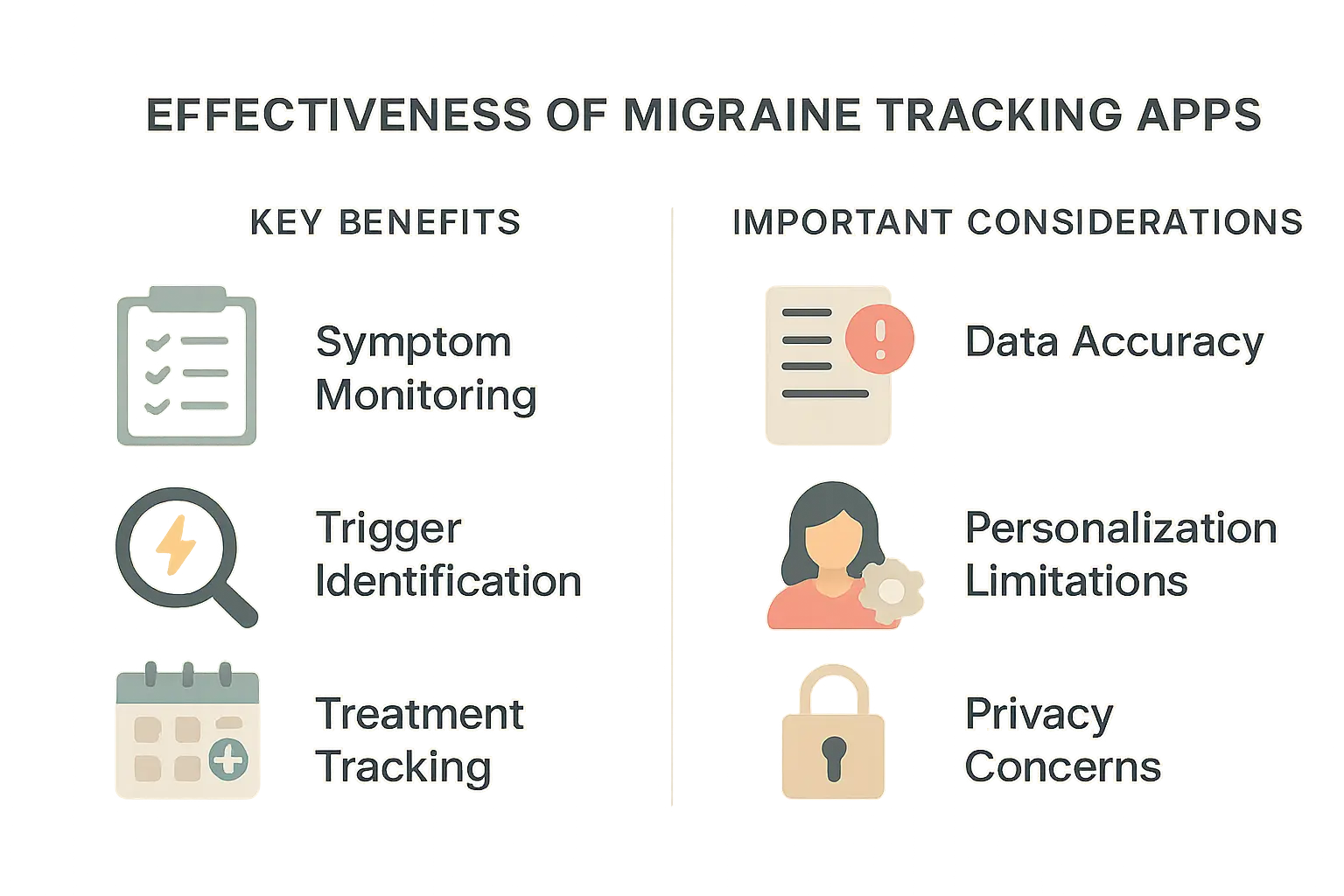
So, do they work? Yes, but perhaps not for the reasons you’d think. Their greatest strength lies in fostering self-awareness and providing concrete data for you and your healthcare team. The act of tracking is often more important than the specific app you use.
| Advantages | Disadvantages & Risks |
|---|---|
| Empowers You: Helps you identify personal triggers and patterns, giving you a sense of control. | Privacy Concerns: Your sensitive health data may be shared or sold without strong legal protection. |
| Improves Doctor Visits: Provides accurate, detailed reports to help optimize your treatment plan. | Effectiveness Varies: Advanced features may not be more effective than a simple paper diary. The benefit often comes from the act of tracking itself. |
| Access to Tools: Many apps include proven relaxation and CBT techniques to help manage attacks. | Potential for Anxiety: Constant symptom monitoring can sometimes increase health-related anxiety for some individuals. |
| Community Support: Some apps connect you with others who understand what you’re going through. | Lack of Scientific Rigor: Many apps are developed without clinical expertise or validation. |
What You Can Do Today: Practical Steps
If you’re considering using a tracking app, or already are, here’s how to approach it wisely.
- Read the Privacy Policy. I know, it’s boring. But you need to know who has access to your data. Look for clear language about data sharing and advertising. If you can’t find it, or don’t understand it, that’s a red flag.
- Focus on the Basics. Don’t get distracted by complex features. The most important variables to track are frequency, duration, intensity, and medication use. Any app (or notebook) can do that.
- Share with Your Doctor, Not the World. The goal is to create a useful report for your healthcare provider. Use an app that allows you to easily export your data as a PDF or spreadsheet.
- Never Change Treatment Based on an App. An app is a tool, not a doctor. Always discuss any changes to your medication or management plan with a qualified professional.
Ultimately, the decision is yours. These apps can be a fantastic ally in your fight against migraine, but you have to go in with your eyes open. You are not alone in this journey. Every small step you take to understand your condition is a victory. Keep tracking, keep learning, and keep advocating for your health.
Your phone, your head, and the promise of relief
I remember those moments all too well. Curled up in a dark room, head pounding, feeling completely helpless. In that desperation, you reach for anything that might offer a sliver of hope. For many of us now, that means reaching for our phones.
There’s an app for everything, right? So, of course, there are apps promising to help us manage our migraines. They offer a modern solution, a sense of control right in our pocket. But let’s be honest. Do they actually work?
Living with migraine means questioning everything, and these apps are no exception. On one hand, they represent the hope of finally understanding our triggers and patterns. On the other, there’s a healthy dose of skepticism. Is tracking your migraine just another task on an already overwhelming to-do list?
Together, let’s look at what the data says, what our community has found, and what it all means for you. You’re not alone in asking these questions. Let’s explore the answers, one step at a time.
The power of the diary, digitized
If you’ve lived with migraines for any length of time, you’ve probably heard about keeping a migraine diary. For years, it was a pen-and-paper affair. A noble effort, but let’s be honest, who remembers to fill out a notebook when a migraine hits? Or finds it later?
This is where tracking apps come in. They aren’t some magical new invention; they simply digitize a powerful, long-standing tool. And they do it incredibly well. Healthcare professionals actively encourage this kind of tracking for one simple reason: it provides real-time data.
Forget trying to recall details from last week’s attack. An app captures information in the moment, making it far more accurate than human memory, especially when you’re in pain. This data becomes a bridge between you and your doctor, a shared language to fine-tune your diagnosis and explore the right treatment options for you.
Think of the app as your objective memory. It doesn’t just remember you had a migraine; it remembers the specifics. Based on what thousands of users in our community track, these are the key details that make a difference:
- Tracking the specifics of each attack: its intensity, duration, and the exact location of the pain.
- Identifying potential migraine triggers, like certain foods, weather changes, hormonal cycles, stress, or lack of sleep.
- Generating clear reports and graphs to share with your healthcare team.
- Providing tools for active management, such as mindfulness exercises or breathing techniques.
This detailed log helps you and your doctor pinpoint patterns you might never have noticed otherwise. This helps you and your doctor pinpoint potential migraine triggers, which is a huge step forward. It’s no longer a guessing game. It’s about gathering evidence to understand what works for you and what doesn’t. Every entry is a small step toward gaining more control.
What the science says: a reality check
Personal stories are powerful. They connect us. But for managing migraines, we also need hard data from clinical studies. I’m not a doctor, but I’ve spent years digging into the research. So, let’s see what the science says together.
A study from NYU Langone Health on an app called RELAXaHEAD showed promising results. Daily users saw their migraine frequency and intensity drop by nearly 50%. That’s a huge number. The app uses progressive muscle relaxation (PMR), a well-established, Grade A method for migraine prevention that targets tension and stress.
But here’s the “yes, but…” moment. That study was small, with only 69 people. It also didn’t account for medications taken simultaneously. This doesn’t invalidate the results, but it adds important context. It’s just one piece of the puzzle.
When we look at larger, more rigorous studies—Randomized Controlled Trials (RCTs)—the picture gets more nuanced. A major German study found that simply keeping a basic diary led to a reduction in migraine days. The group using a fancy app with extra features didn’t show a statistically significant advantage over those using just a simple digital log.
This suggests the very act of tracking is what makes a difference. It forces you to connect with your body and your patterns.
| Feature | Proven Benefit (based on studies) | Important Caveat |
|---|---|---|
| Basic Symptom & Trigger Diary | Helps identify patterns and improves communication with doctors. | Similar benefits can be achieved with a simple paper diary. |
| Guided Relaxation (e.g., PMR) | Clinically shown to reduce migraine frequency/intensity in some users (RELAXaHEAD study). | Effectiveness depends on consistent use; studies are often small-scale. |
| Advanced Analytics & Reports | Provides structured data for medical appointments. | No clear proof that this feature itself reduces migraine days more than basic tracking. |
| Educational Content | Empowers the user with knowledge about their condition. | Does not replace professional medical advice. |
So, what’s the takeaway? Science confirms that tracking your migraines is undeniably beneficial. It empowers you and improves the conversation with your doctor. However, the “miracle” app doesn’t exist. The real effectiveness comes from you—how consistently you use the tool and integrate those insights into your management plan with your healthcare provider.
The dark side of data: privacy risks you can’t ignore
You’re sharing your most vulnerable moments with an app. But who else is listening? It’s a tough question we must ask. After all, these aren’t just data points; this is the story of our health.
When tracking your life with a migraine app, you’re handing over incredibly sensitive information. It’s not just your migraine symptoms. It often includes menstrual cycles, stress levels, sleep habits, and your location—a detailed map of your well-being.
Here’s the hard truth. Most of these apps aren’t bound by strict privacy laws, like HIPAA in the US, that protect your official medical records. Your doctor can’t share your file without consent. For an app, the rules are far murkier.
This creates real risks. Your personal data could be sold to third parties like advertisers or used for targeted marketing that preys on your health concerns. Worse, weak security could expose your information to hackers. Convenience must be weighed against these dangers.
I’m not a security expert, but I’ve learned to be cautious. Here are practical steps to protect yourself:
- Read the privacy policy: It’s long, but search for keywords like “third parties,” “advertising,” or “sell.” What you find might be surprising.
- Check the company’s location: Data protection laws vary greatly. An app based in a region with strong privacy laws is a safer bet.
- Use minimal personal information: If an app doesn’t need your full name or address, don’t provide it.
- Consider apps that store data locally: Some apps let you keep data on your device, a powerful feature for privacy.
Ultimately, convenience should never overshadow the protection. It’s a trade-off each of us must evaluate consciously. You are the guardian of your information; make an informed choice.
Making it work for you: your practical action plan
So, how can you make these apps a powerful ally instead of just another task? It’s about being smart and intentional. From my own journey and our community’s data, I’ve learned a few things. Let’s turn that information into your personal action plan.
Here’s what you can do, starting today.
Step 1: Consistency is key
Your tracking your migraine journey is a marathon, not a sprint. To get a clear picture, log your data regularly—even on good days. Those pain-free days are your baseline, providing the contrast needed to spot what’s different when an attack hits. It might feel like a chore at first, but it quickly becomes a powerful habit.
Step 2: Don’t just track, analyze
Entering data is only half the battle. The real magic happens when you review it. Set aside time to look at the reports your app generates. Look for patterns. Was it the late-night pizza or the lack of sleep that followed? The app provides clues; you become the detective, connecting the dots in your own migraine story.
Step 3: Share with your doctor
This is the ultimate goal. Your app data is a bridge to your healthcare professional. Before each appointment, export the report. Presenting clear, organized data transforms the conversation, making it more productive. Understanding these patterns can truly change your migraine daily life management.
Step 4: Listen to your gut
Remember, the app is a tool, not an oracle. It’s there to serve you. If tracking makes you more anxious, it’s okay to take a break. The goal is to reduce the burden of migraine, not add another layer of stress. Your well-being always comes first.
So, what’s the verdict?
So, do migraine tracking apps really work? The answer is a classic migraineur’s response: it depends. Having lived with migraines for years, I know we look for any tool to regain control. These apps can be part of that toolkit, but they aren’t a magic wand.
Let’s be clear. Yes, they are excellent tools for collecting data. They help you spot patterns you might otherwise miss, providing concrete information for your doctor. Many in our community find them invaluable for this reason.
But no, they are not a miracle cure. The scientific proof of their superiority over a simple paper diary is still debated. Their real power lies in how consistently you use them.
And we must address the elephant in the room: the privacy risks are real. You’re sharing sensitive health data, so be critical about who you’re sharing it with. Always check the privacy policy.
Ultimately, an app’s effectiveness depends less on its features and more on how you use it with your healthcare provider. You are not alone. Every step to understand your body is a victory.
Start tracking, stay critical, and keep talking to your healthcare professionals. You’ve got this.
Sources
Pour aller plus loin et approfondir les informations partagées dans cet article, je vous encourage à consulter les ressources. Elles sont une mine d’or pour quiconque souhaite mieux comprendre les outils à notre disposition.
- Healthify NZ – Migraine and headache apps
- Migraine Again – Best Migraine Apps for Tracking Headaches
- Minen, M. T., et al. (2021). Effect of a Smartphone-Based, Behavioral Intervention on Migraine Disability in Patients Discharged From an Emergency Department: A Randomized Clinical Trial. JAMA Network Open.
So, do migraine tracking apps really work? The answer is a classic migraineur’s response: it depends.
Yes, they are great for collecting data to identify patterns. No, they aren’t a magic cure, and their superiority over a simple diary is unproven. Crucially, the privacy risks are real.
Effectiveness depends on how you use the app with your doctor.