
Have you ever felt betrayed by a meal, wondering if that delicious bite of aged cheese or that glass of red wine was the cause of your latest migraine? Identifying the specific foods that trigger migraines is a frustrating journey many of us share, but it doesn’t have to be an endless guessing game. Based on community data and established studies, this article will guide you through the common suspects without creating a list of forbidden foods. Together, we’ll explore the science behind these triggers and, more importantly, learn practical steps to become the detective of your own body to find what truly matters for you.
- That innocent-looking meal: why food triggers are so personal
- The usual suspects: common foods on the migraine radar
- Trigger or symptom? the great chocolate debate and the prodrome phase
- Beyond specific foods: the bigger picture of your diet
- Your practical action plan: how to become your own migraine detective
- You are not alone in this food journey
- References
That innocent-looking meal: why food triggers are so personal
I still remember it clearly. A wonderful dinner with friends, full of laughter and delicious food, followed hours later by the familiar, devastating throb of a migraine. The inevitable question haunted me: “Was it the aged cheese? The single glass of red wine? Or just… bad luck?” If you live with migraine, you know this feeling. It’s like walking on eggshells in your own kitchen.
You start to see every meal as a potential minefield. This constant questioning is exhausting, and it’s a reality for so many of us. Our community data, gathered from thousands of users, is filled with this shared confusion.
But here’s the first, most crucial thing I’ve learned on this journey, and I want to share it with you. There is no magic list of “bad” foods. A specific food might be a clear migraine trigger for one person and completely harmless for another. It is deeply, frustratingly, and liberatingly personal.
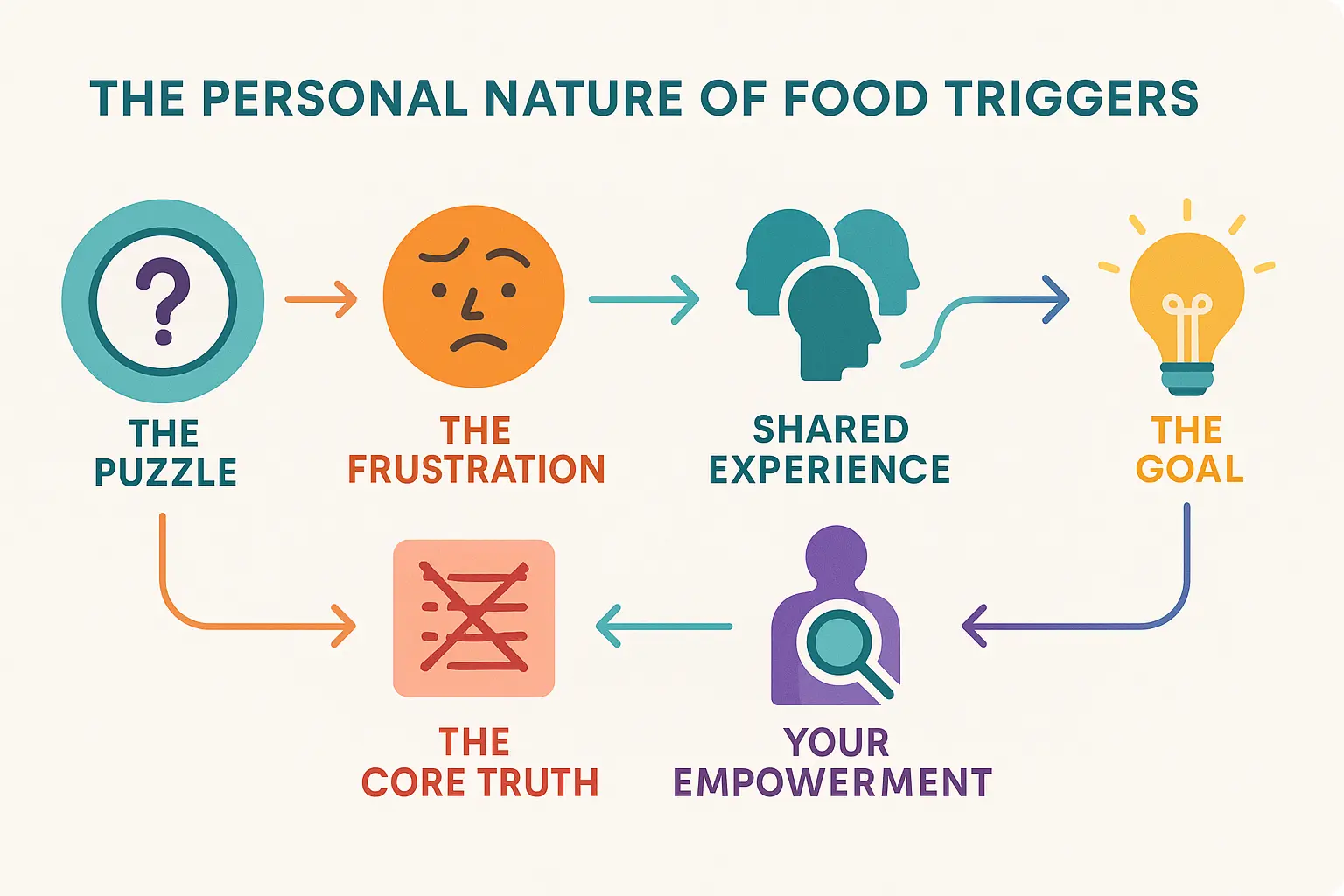
This isn’t about creating a long list of forbidden foods. That approach often leads to unnecessary anxiety and nutritional gaps. Instead, think of this as a guide to help you become the lead detective of your own body. The goal isn’t restriction; it’s understanding.
The real power comes from figuring out what works for you. It’s about careful observation, not blind elimination. So, how do we start to unravel this complex puzzle and separate the real culprits from the innocent bystanders? How do you find what truly matters for your migraine?
The usual suspects: common foods on the migraine radar
When you live with migraine, your plate becomes a detective scene. You question everything. Was it the cheese? The glass of wine? It’s a familiar story in our community. While I’m not a doctor, years of tracking my own migraines and analyzing data from thousands of users have taught me that food is a powerful piece of the puzzle.
Let’s be clear: there is no universal “migraine diet.” What triggers an attack for one person might be fine for another. However, certain foods and the compounds they contain are frequently cited as potential culprits. Think of this list not as a set of rules, but as a starting point for your own investigation.
Certain substances, often forming as food ages or is processed, appear to be the main suspects. They can affect blood vessels or nerve pathways in ways that, for a migraine-prone brain, can be the final straw.
| Potential Trigger (Compound) | Commonly Found In | What to Know |
|---|---|---|
| Tyramine | Aged cheeses (cheddar, blue cheese, brie), cured meats, smoked fish, some beans. | A substance that forms as proteins in food break down over time. Levels increase in aged or fermented foods. |
| Alcohol (especially red wine) | Red wine, beer, whiskey, champagne. | Contains tyramine and histamines, and can lead to dehydration—a well-known trigger in itself. |
| Caffeine | Coffee, tea, soda, energy drinks. | This one is complicated. It can help, but caffeine withdrawal is a major trigger for many. |
| Nitrates & Nitrites | Processed meats like hot dogs, bacon, deli meats, sausages. | Preservatives that can dilate blood vessels, potentially leading to a migraine. |
| MSG (Monosodium Glutamate) | Soy sauce, processed foods, fast food, seasoning blends. | A flavor enhancer. Its role is debated, but many people report sensitivity. |
| Artificial Sweeteners (Aspartame) | Diet sodas, sugar-free products, yogurts. | A common suspect, though scientific evidence remains mixed. |
| Chocolate | Cocoa-based products. | Often craved during the prodrome phase, making it hard to tell if it’s a trigger or a symptom. |
Seeing this list can feel overwhelming. I get it. But please, don’t rush to ban all these foods. The goal isn’t restriction; it’s understanding. This is a guide to help you pay closer attention. Your most powerful tool is observation—tracking what you eat and how you feel. Each discovery is a step toward gaining more control.
Trigger or symptom? the great chocolate debate and the prodrome phase
Here’s a question I’ve asked myself countless times. What if that intense craving for chocolate wasn’t the cause of your migraine, but the very first sign it was already on its way?
This idea can completely change how you see your migraine patterns. It introduces us to a crucial, often misunderstood concept: the prodrome phase. This is the period, lasting from a few hours to even two days before the pain hits, where your brain is already starting to change.
Many of us experience it without realizing what it is. Common prodrome symptoms include unexplained fatigue, frequent yawning, mood swings, and, most importantly, food cravings. Sound familiar?
Chocolate is the perfect case study here. For years, I, like many in our community, blamed that square of dark chocolate for the debilitating pain that followed. You feel an irresistible urge, you eat the chocolate, and then the migraine arrives. The conclusion seems obvious. Blame the chocolate.
But what if we’ve been looking at it backwards? Many neurologists now suggest an alternative theory that resonates with thousands of user experiences we see. The craving itself was the symptom, not the trigger. Your brain, already entering “migraine mode,” was sending out signals, perhaps for a quick energy boost from sugar or for a dose of magnesium.
This isn’t just about chocolate. It applies to other common cravings for salty or sweet foods too. Understanding this distinction is a game-changer for tracking your migraines. It shifts the question from just “What did I eat?” to “What did I crave, and when?” This helps differentiate between the different types of migraines and their unique warning signs.
Beyond specific foods: the bigger picture of your diet
For years, I obsessed over every single food on my plate, convinced that eliminating one more thing would be the magic bullet. Sound familiar? While identifying specific food triggers is part of the puzzle, focusing only on elimination is a narrow and often frustrating path. Sometimes, how and when you eat matters far more than what you eat.
Think of it like this: your body has a “migraine threshold.” It’s like a bucket. A single drop—one food item—rarely makes it overflow. But add a night of poor sleep, a stressful day, and then a skipped meal… suddenly, the bucket spills over. That’s your migraine attack. Many common migraine triggers are cumulative.
So, instead of just removing things, let’s focus on building a stable foundation. Based on data from our community and what studies confirm, three pillars are often more impactful than any restrictive diet.
First, consistency is key. Your brain loves routine. Skipping a meal, especially breakfast, causes a drop in your blood sugar (hypoglycemia). For many of us, this is a powerful and well-documented trigger that sends a stress signal to the brain.
Second, hydration, hydration, hydration. This sounds too simple, but I can’t stress it enough. Dehydration is one of the most common and easily avoidable triggers. Don’t underestimate it. Keeping a water bottle with you isn’t just a healthy habit; for us, it’s a core defensive strategy.
Finally, think about balanced meals. Combining protein, complex carbs, and healthy fats helps keep your blood sugar stable. This prevents the sharp spikes and crashes that can put your brain on high alert. A steady energy supply is a calm brain.
Here’s a simple checklist you can start using today. It’s not about perfection; it’s about stability.
- Your daily stability checklist
- Eat your meals at roughly the same time every day.
- Never skip breakfast.
- Keep a water bottle with you and sip throughout the day.
- Include a source of protein in every meal to stay full and stable.
Your practical action plan: how to become your own migraine detective
We’ve covered the common suspects. Now, let’s turn that confusion into action. Feeling empowered is the first step, and you are not helpless in this. Your most powerful tool isn’t a complex test; it’s a simple notebook or an app—your migraine food diary. Memory is unreliable during or after an attack. We need data, not guesses.
Step 1: Track Everything (for a while)
A migraine is rarely caused by a single thing. It’s more like a threshold crossed when several factors pile up. For a few weeks, your mission is to become a meticulous observer of your own life. It’s a short-term project for long-term gain.
What to log in your migraine diary:
- What you ate and drank: Be specific (e.g., “cheddar cheese,” not just “cheese”).
- When you ate: The time is crucial.
- Your sleep: Note the quality and duration.
- Your stress level: A simple 1-10 scale works.
- For women, your menstrual cycle: Hormones are a huge factor.
- Any migraine symptoms: Log the time they start, even the mild ones.
Step 2: Look for Patterns
After a few weeks of consistent tracking, it’s time to play detective. With a clear head, review your notes. Look for foods or habits that consistently appear within the 24 hours before a migraine starts.
A word of caution: don’t jump to conclusions. If you ate bread daily but only had three migraines, bread isn’t the likely trigger. Look for what’s different on your migraine days. Was it the wine? That leftover Chinese food?
Step 3: The Elimination Diet (Carefully)
If a clear suspect emerges, you can try an elimination test. Remove that one food completely for 4 to 6 weeks and observe any changes in your migraine frequency or intensity.
The key is one food at a time. Eliminating ten things at once teaches you nothing. And remember, I’m sharing from my experience, not as a doctor. Before starting any restrictive diet, please talk to your doctor or a dietitian to do it safely.
Each small step is a victory. You’re gathering clues to understand your body better, and that is incredibly powerful.
You are not alone in this food journey
Navigating the world of foods that trigger migraines is definitely a marathon, not a sprint. I know how overwhelming it can feel. But please, remember this journey is about progress, not perfection.
The real key is self-knowledge. It’s about understanding that consistency in your habits often matters more than strict restriction. It’s also about learning to distinguish a craving that is a symptom from a food that is a true trigger. A subtle but powerful shift.
Be patient and kind to yourself. There will be good days and bad days. I’ve had plenty of both. Each crisis isn’t a failure; it’s an opportunity to learn something new about your own body. That’s a win.
You don’t have to do this alone. In fact, you shouldn’t. Talking to a doctor, a neurologist, or a dietitian is a fundamental step. They can provide guidance that is tailored just for you.
Most importantly, know that you are part of a huge community. Thousands of us are learning every single day, sharing our discoveries, and supporting each other through this. Every small step you take to understand your body is a victory. So, maybe start your journal today. Just one note at a time.
References
- Healthline: Foods That Trigger Migraines
- UC Davis Health: Migraine Diet Table (Oto-migraine-diet-table.pdf)
- Migraine Meanderings: Beyond Medication: Diet and Migraine Management
- American Migraine Foundation: The Long-Awaited Diet for Migraine Post
Navigating the world of foods that trigger migraines is a marathon, not a sprint. Remember: self-knowledge is your greatest tool, consistency often matters more than restriction, and what you crave might be a symptom, not a cause. Be patient with yourself. Every step you take to understand your body is a victory.